
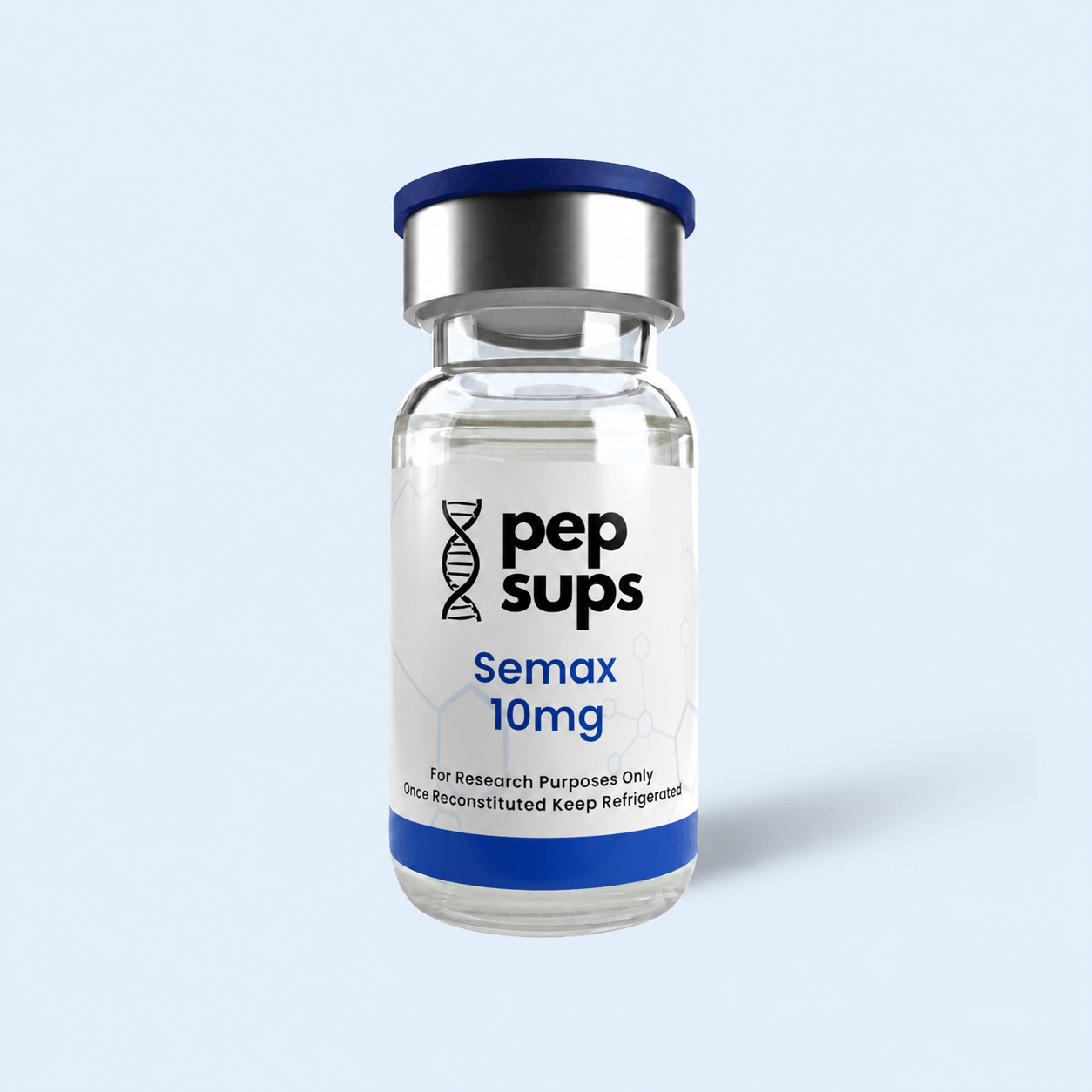
Semax 10mg
What is Semax?
Semax is a synthetic heptapeptide originally developed from a fragment of adrenocorticotropic hormone (ACTH 4-10). Designed by researchers in Russia, it has become one of the most extensively studied nootropic peptides due to its potential influence on cognitive function, neuroplasticity and neurological signalling.
Unlike the full ACTH hormone, Semax was engineered to retain neurological activity while avoiding the hormonal effects associated with ACTH. The addition of a Pro-Gly-Pro sequence increases its resistance to enzymatic degradation, improving stability for research applications.
Today, Semax continues to be investigated across a range of neuroscience and neurobiology studies.
Structure and Origin
Semax is a synthetic analogue of the ACTH (4-10) fragment and consists of seven amino acids.
Amino acid sequence:
Met-Glu-His-Phe-Pro-Gly-Pro
The peptide was developed at the Institute of Molecular Genetics of the Russian Academy of Sciences during research into compounds capable of supporting neurological function and cognitive performance.
How Does Semax Work?
The exact mechanisms of Semax are still being investigated. Research suggests that rather than acting through a single receptor, Semax appears to influence multiple neurological signalling pathways simultaneously.
Areas currently under investigation include:
- Brain-derived neurotrophic factor (BDNF) expression
- Nerve growth factor (NGF) signalling
- Dopamine regulation
- Serotonin pathways
- Melanocortin receptor activity
- Neuroplasticity
- Gene expression involved in neuronal communication
These complex interactions have made Semax a popular subject in neuroscience research.
Current Areas of Research
Semax has been investigated in numerous laboratory and clinical research settings involving:
Cognitive Performance
Researchers continue studying Semax for its potential effects on attention, learning, memory formation and information processing.
Neuroprotection
Experimental studies have explored whether Semax influences biological pathways involved in protecting neurons during periods of stress or injury.
Brain Plasticity
Semax is frequently investigated for its possible role in regulating neurotrophic factors associated with neuronal growth and synaptic plasticity.
Stroke and Neurological Recovery
Some of the earliest clinical research involving Semax focused on neurological recovery following stroke and cerebral ischaemia, particularly within Russian medical research.
Stress Response
Laboratory studies have also examined how Semax may influence behavioural and physiological responses associated with stress.
Why is Semax Popular in Research?
Semax remains one of the most recognised cognitive peptides because of its extensive research history and unique mechanism of action.
Researchers are particularly interested in its:
- Well characterised peptide structure
- Long history of scientific investigation
- Influence on neurotrophic signalling
- Potential effects on cognitive processes
- Broad applications within neuroscience research
Compared with many newer peptides, Semax has a comparatively large body of published research available for review.
Storage
Semax is commonly supplied as a lyophilised (freeze dried) powder to maximise long-term stability before use in laboratory settings.
General storage recommendations include:
- Store unopened vials in a cool, dry location.
- Protect from moisture and direct sunlight.
- Refrigerate after reconstitution according to laboratory protocols.
- Avoid repeated freeze-thaw cycles.
Frequently Asked Questions
What is Semax?
Semax is a synthetic heptapeptide derived from the ACTH (4-10) fragment. It is primarily investigated in neuroscience and cognitive research.
Is Semax naturally occurring?
No. Semax is a synthetic peptide created by modifying a naturally occurring fragment of ACTH to improve stability while maintaining neurological activity.
What is Semax being researched for?
Current research includes cognition, learning, memory, neuroplasticity, neuroprotection, stress response and neurotransmitter regulation.
Is Semax approved as a medicine?
Semax has been used clinically in Russia for certain neurological indications, but it is not approved as a medicine in many other countries, including the UK and the United States.
Why is Semax supplied as a powder?
Lyophilisation improves peptide stability during storage and transportation, allowing researchers to reconstitute the peptide when required.
Disclaimer
Semax is intended solely for scientific and laboratory research. It is not approved for general medical use in many jurisdictions, and ongoing research should not be interpreted as evidence of established clinical efficacy. Any research involving peptides should comply with applicable laws, regulations and institutional guidelines.
Reviews
There are no reviews yet.